Today I helped my wife set up her second brain
She is ready to start a new job as a senior media buyer feeling confident in her skills
Oct 19, 2026
My wife just got a new job at a big advertising agency as a senior media buyer and she starts next week. Today we were chatting about her onboarding schedule during breakfast and I felt like her "first day at school" jitters are starting to kick in.
She mentioned feeling insecure about all the new ad platforms she will have to learn and work on. She asked if I had any thoughts on how to onboard smoothly and become a high performer on her team.
Honestly, I'm no performance coach, but I've been working in a big agency for a while. I first joined as a senior data analyst and in the past couple of years I got promoted to analytics manager based on good performance.
I'm also not a media buyer, but I read more productivity books than I can count. From waking up at 4AM, doing daily cold plunges, creating kanban boards, and scheduling pomodoro time blocks, I feel like I've tested a bunch of tools, frameworks, and routines. Some worked well, some didn't (I still wake up at 8AM and take hot showers). But I thought I might be in a good position to share what worked for me.
I opened my toolbox looking for something that might be useful for someone starting a new job. After digging through some notes in my Obsidian vault, I found this one that said: "Knowledge work is about managing information effectively".
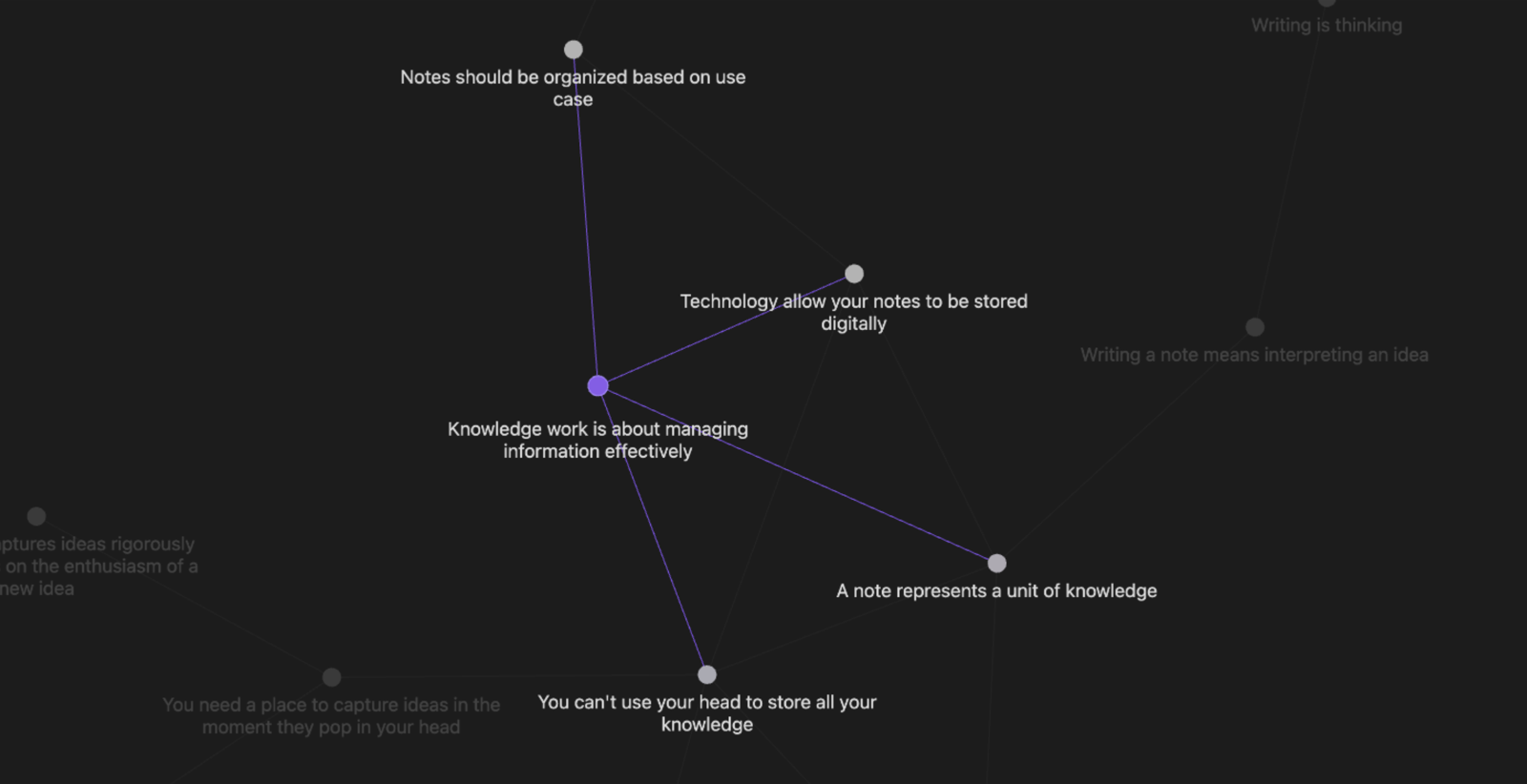
This is a useful note for her, I thought. After all, she is a knowledge worker who will have to deal with a ton of new information in her new job. When I opened the note, it said:
"We live in a world where distracted people are overwhelmed by the volume of information they have to manage every day. Managing information effectively is a competitive advantage. You should not waste your time and energy looking for old emails or trying to remember what was said during a meeting that happened weeks ago. Staying late in the office every day searching for files, emails, and presentations is not a sign of success, it's a sign of burnout."
Again, useful context. Starting a new job is overwhelming. There are new people to meet, new processes to learn, new systems to master. If she finds a way to manage information effectively, she will likely become a high performer on her team.
As a bonus, if she manages information effectively, she can be home early instead of staying late in the office wasting time searching through emails, remembering meetings, and making the same presentation for the tenth time.
Now the question is: how can she manage information effectively? This is not mentioned in the note, but might be somewhere near. I kept digging through the connected notes.
The "knowledge work" note was also linked to some useful notes, like "You can't use your head to store all your knowledge", "A note is a unit of knowledge", and "Technology allows your notes to be stored digitally". But none of these notes offered a structured method to help her.
That's when I realized all notes in this neighbourhood had the same root: the book "Building a Second Brain", by Tiago Forte. A couple of links away, I found a note that summarized Tiago's approach to building a second brain.
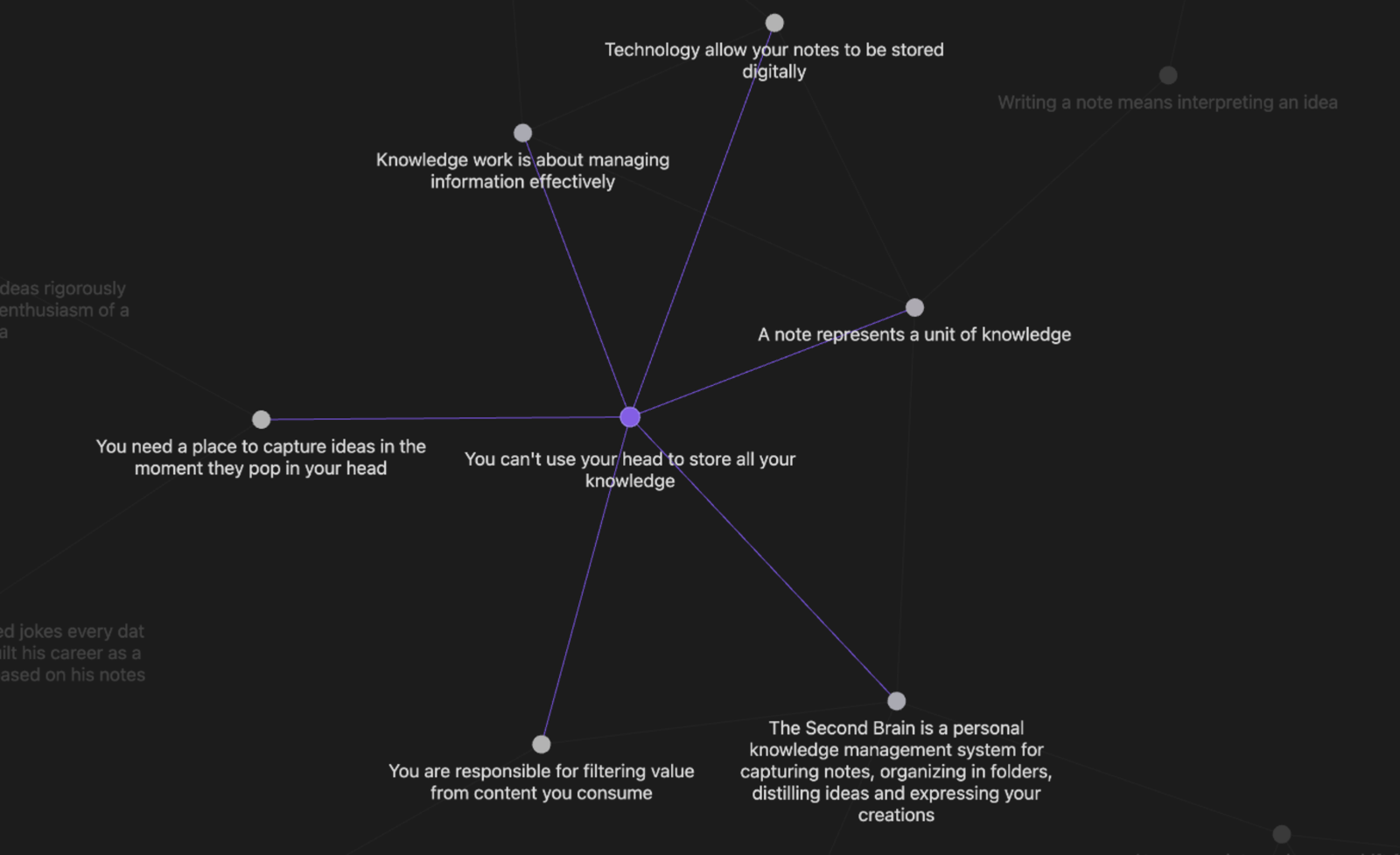
The note said: "The Second Brain is a personal knowledge management system for capturing notes, organizing in folders, distilling ideas and expressing your creations". When I opened the note, it said:
The "Second Brain" is a personal knowledge management (PKM) system created by Tiago Forte. It can be used for storing notes, connecting ideas, and creating things. It works like a private knowledge collection, a laboratory for new ideas, and a digital garden for cultivating your creations. It is a mind cathedral where you can go alone to think, as well as a repository of things you create.
The Second Brain system follows a process called "CODE", which means Capture, Organize, Distill, and Express. Capture means taking notes about any idea that resonates, based on your intuition. Organize means placing notes where they are more likely to be used, based on a folder hierarchy called "PARA", acronym for Projects, Areas, Resources, and Archive. Distill means getting to the essence of an idea using Progressive Summarization. Express means sharing your work as early as possible and as frequently as possible, to capture feedback from other people.
This is a great note. But it's also a lot to unpack for someone who has never read Tiago's book. So I broke the ideas into three steps to help her set up a second brain:
First, I explained that the second brain is a personal knowledge system that can be implemented in tools like Notion, Evernote, or Obsidian. She was already into Obsidian because I've been using it and telling her how great it is for some time. Obsidian is a free note-taking app, essentially a text editor. It works well on her iPhone and Mac, via iCloud. Also, it integrates easily with Claude for searching notes and doing cleanups. I avoid using Claude for knowledge-related activities (like writing notes, distilling notes, connecting notes), but Claude can be a time saver for admin work. So she went ahead and downloaded Obsidian.
Second, I explained that the second brain is organized in four folders: Projects, Areas, Resources, and Archive. She went ahead and created the folders. She also decided to create one project note called "onboarding" (following the 30-60-90 onboarding approach), one area note called "people" (to store what she knows about her new coworkers), and one resource folder to store study notes for each ad platform she will use (Meta, Snapchat, CM360, DV360, and The Trade Desk). Yes, it's a lot of ad platforms.
Third, I explained that from now on, she will have to keep a habit of capturing notes about projects, people, processes, and ad platforms, for example. She will also have to make sure these notes are organized in the right folders. From time to time she will have to go back to these notes and summarize them, as well as archive the ones that are not useful anymore.
After a couple of hours setting up her second brain in Obsidian, it took her another hour (and a grilled cheese break) to wrap her head around the process of feeding and maintaining the system.
But now she's not looking insecure anymore.
She's looking curious, engaged, and focused on studying ad platform documentation. She's already making some good-looking notes and feeling ready to face a new professional challenge.