3 things I learned reading Deep Work
Cal Newport’s rules for focused success in a distracted world
Oct 22, 2026
Cal Newport is a computer science professor at Georgetown University. He received a Ph.D. in computer science from MIT in 2009 and worked as a post-doctoral associate researching distributed algorithms until 2011, when he joined Georgetown.
Beyond academic papers, Newport also wrote many books about productivity and attention management in the digital world, like Slow Productivity (2024), A World Without Email (2021), Digital Minimalism (2019), Deep Work (2016), and So Good They Can't Ignore You (2012).
Honestly, I'm a big fan of his work. I also studied computer science, so I share his passion for dissecting algorithms, and I've spent a good part of my career reflecting on how to be productive. In the last three years I've been working on building data and business intelligence systems in the advertising industry. It's a naturally creative, chaotic, and media-oriented industry, so I have to deal with a lot of distractions every day.
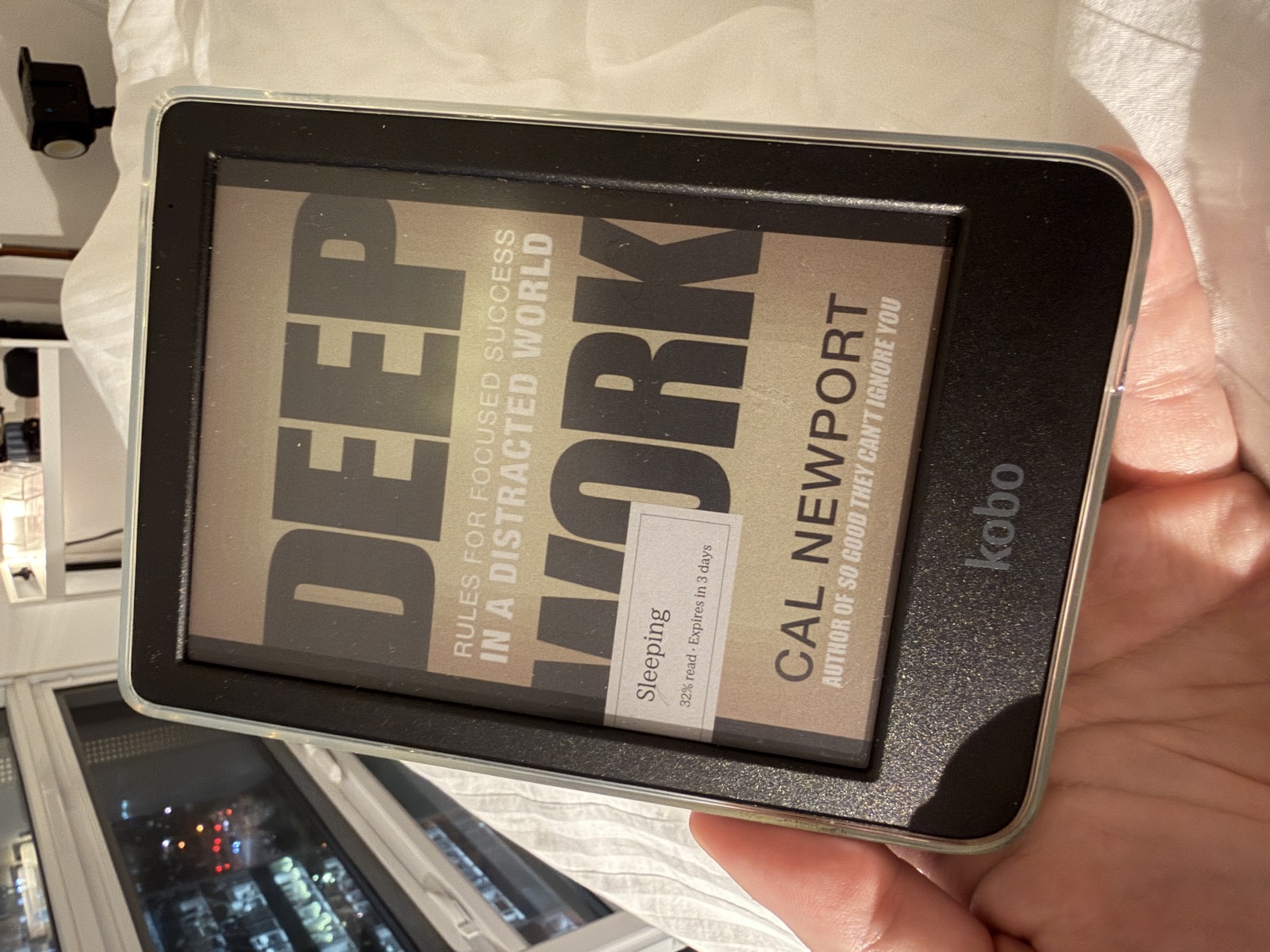
Newport's books have helped me a lot so far. I started with Slow Productivity. It guided me to calm down my productivity anxiety and really think about the things that matter in my day. I thought it was a good book with good insights. Then I read Deep Work. It was something else.
Since I finished reading Deep Work, a couple of weeks ago, I've noticed a profound impact on my behavior and the way I deal with distraction. Three things happened:
(1) I became aware of mindless Internet consumption. I reduced the use of social media, instant messaging, and streaming apps.
(2) I started hearing my own thoughts. Whenever I'm commuting, running, or grocery shopping, there is no Internet stimulus anymore. The podcast in the background was replaced by a voice in my head that helps me develop my thoughts.
(3) I incorporated writing as part of my thinking. I'm not just writing for a blog or newsletter anymore. I'm writing to think. Writing became a way to record the conversations I have in my head and document my thoughts in a personal knowledge system.
I'll dive deeper and explain how each of these things happened. Let's start with number one.
I became aware of mindless Internet consumption
Before reading Deep Work, my typical workday would go like this: wake up and check my Instagram feed for half an hour in bed; cook breakfast listening to a Spotify playlist; walk to work listening to a podcast on Spotify; alternate between meetings and checking my LinkedIn feed; walk back home listening to a YouTube monologue; exercise while listening to another Spotify playlist; and spend the rest of the day watching series with my wife on Netflix, Apple TV, Amazon Prime Video, or Disney+.
I thought this was normal. After all, that's how most people I know behave. Looking back at my screen time from a couple of weeks ago, I clocked four hours on my phone, received eighty notifications, and picked it up sixty times every day, on average.
Again, for most people this is what routine looks like: we work eight hours, sleep eight hours, and spend the rest of the day trying to entertain our brains with media.
It didn't take long for Newport to convince me I could be doing better things with my time. I could read a book to solve a problem at work. I could read about exercising, eating healthier, and communicating with my partner. I could even write about my learnings and share them with other people. All these ideas seemed nice. But as the chapters passed, I realized that getting time back from media consumption was just the tip of the iceberg.
Newport brings research showing that mindless content consumption also hurts your brain's ability to learn new skills and produce high-quality work. "Constant attention switching online," Newport says, "has a lasting negative effect on your brain (...) People who multitask all the time can't filter out irrelevancy. They can't manage a working memory. They're chronically distracted. They initiate much larger parts of their brain that are irrelevant to the task at hand... they're pretty much mental wrecks."
I genuinely thought I could turn off my phone whenever I needed to focus on my work. Turns out my brain doesn't work this way. According to neuroscientists cited by Newport, when you focus on a single task at a time, the brain develops myelin around neurons, which improves your ability to develop new skills and produce high-quality work. Here is a passage I extracted from the book:
Skills, be they intellectual or physical, eventually reduce down to brain circuits. This new science of performance argues that you get better at a skill as you develop more myelin around the relevant neurons, allowing the corresponding circuit to fire more effortlessly and effectively. To be great at something is to be well myelinated. (...) Why it's important to focus intensely on the task at hand while avoiding distraction is because this is the only way to isolate the relevant neural circuit enough to trigger useful myelination. (...) To learn hard things quickly, you must focus intensely without distraction. To learn, in other words, is an act of deep work.
Once I realized I could have a significant amount of time back as well as improve my ability to learn new things and produce high-quality work just by focusing on single tasks, I deleted all these apps from my phone.
I followed James Clear's advice (Atomic Habits) on how to break bad habits: make it invisible, unattractive, difficult, and unsatisfying. No apps, no media consumption. For a week or two, I was just bored, and then something unexpected happened.
I started hearing my own thoughts
I started hearing a voice in my head, especially in the boring moments, when I was grocery shopping, walking to work, or running on a treadmill with no podcast in the background.
It didn't happen suddenly. It gradually became a thing. I started to hear my thoughts more and more. It became an internal dialogue that I was able to sustain for more than just a couple of minutes.
At first, I followed Newport's advice and embraced boredom. I started taking care of my brain like an athlete takes care of their body. I made a deliberate effort throughout the day to avoid distractions and the dependence on media consumption.
During moments of extreme boredom, I started practicing something Newport calls "productive meditation." I started focusing on a single problem and trying to isolate and analyze its variables. Here is how he explains this method:
The goal of productive meditation is to take a period in which you're occupied physically but not mentally—walking, jogging, driving, showering—and focus your attention on a single well-defined professional problem. Depending on your profession, this problem might be outlining an article, writing a talk, making progress on a proof, or attempting to sharpen a business strategy. As in mindfulness meditation, you must continue to bring your attention back to the problem at hand when it wanders or stalls. I'm not, however, suggesting this practice for its productivity benefits (though they're nice). I'm instead interested in its ability to rapidly improve your ability to think deeply. By forcing you to resist distraction and return your attention repeatedly to a well-defined problem, it helps strengthen your distraction-resisting muscles, and by forcing you to push your focus deeper and deeper on a single problem, it sharpens your concentration. To succeed with productive meditation, it's important to recognize that, like any form of meditation, it requires practice to do well. (...) "Thinking deeply" about a problem seems like a self-evident activity, but in reality it's not. When faced with a distraction-free mental landscape, a hard problem, and time to think, the next steps can become surprisingly non-obvious. In my experience, it helps to have some structure for this deep thinking process. I suggest starting with a careful review of the relevant variables for solving the problem and then storing these values in your working memory. For example, if you're working on the outline for a book chapter, the relevant variables might be the main points you want to make in the chapter.
Practicing productive meditation was the cure for my boredom. I started practicing it to strengthen my mental muscles and my ability to focus. Then it became fun. Every time I saw myself in a boring situation, I told myself, "okay, I'm bored, what am I going to think about now?"
Boring moments like being in an elevator became amusing because I saw people mindlessly scrolling through their feeds while my brain was overflowing with ideas. Setting aside the deep complexity of the mind, I felt like I was in control of my thoughts.
I was now leading the way. I could chat with myself and have long discussions about things I wanted to create and problems I wanted to solve. Then the internal voice became louder and louder. It became so intense that I had to do something about it.
I incorporated writing as part of my thinking
Writing was the only sane thing to do with that voice in my head. I didn't start writing a daily journal. I didn't set a specific goal or routine for writing. I also didn't intend to share any of my writing. I started writing for me, whenever I felt like it, as a part of my thinking process.
That mindset changed my relationship with the act of writing. All my life I used to write with a final product in mind, like an article, a work presentation, or an academic paper. Now I write just to think.
I write during the productive meditation sessions. After about ten minutes analyzing a thought, the impulse to write and document the thought becomes impossible to ignore. In the past few weeks I wrote ten long notes based on my productive meditation sessions. The list couldn't look more random:
2026-10-12, starting a business vs making content: I compared Ali Abdaal's lifestyle business approach (create a high-ticket 1:1 service offer and acquire customers through warm outreach) with Dan Koe's approach (create a micro-product and a micro-service and acquire customers with content and newsletters).
2026-10-14, feeling adrift: I wrote a deep reflection about the fact that I had been feeling adrift since I turned thirty, and how I can try living a fulfilling life by writing about the things I love.
2026-10-16, acronyms ruin communication: I made a point that acronyms should be avoided in business communication as much as possible. I argued that acronyms are ambiguous, confusing, and an ineffective tool for human communication.
2026-10-17, build a business like you're building a village in Clash of Clans: I made an analogy about how building a lifestyle business as an adult compares to building a Clash of Clans village in high school. This one was the most enjoyable to write, if I'm being honest.
2026-10-17, running slower makes it easier to run more: I explained how I transformed my "easy runs" into "think runs." I started to run slower on a treadmill instead of running faster on the streets. I stopped paying attention to pace control and city traffic, and this allowed me to think more deeply during an easy run.
2026-10-19, today I helped my wife set up her second brain: I documented the fact that my wife is starting a new job in the advertising industry as a media buyer and she asked me for advice on how to be a high performer. I used Tiago Forte's Second Brain approach and helped her set up a knowledge system that she can use to ease her onboarding process.
2026-10-19, how a Brazilian ends up immigrating to Canada: I told my story of leaving Brazil, changing careers from lawyer in Brazil to computer scientist in Canada, diving deep into the thought process of why I picked Canada instead of any other country.
2026-10-22, a case for tacit knowledge in AI data agent development: I made an argument that AI data agents need access to tacit knowledge documentation, not just explicit data and instructions, to improve accuracy.
2026-10-22, 3 things I learned reading Deep Work: the text you are reading right now.
2026-10-23, Luhmann vs Ravikant: I made a comparison between how Niklas Luhmann and Naval Ravikant approached their challenges and ended up with an unexpectedly similar philosophy.
When I stop to think about it, that's a lot of long texts I wrote in a short time. Granted, most are only first drafts. Yet I wrote almost one long text per day. Some on the same day. Some a couple of days apart. I could never dream of writing this much before reading Deep Work.
I might use one of these texts for work, a couple more for Substack articles, and leave the others simmering for days, months, or years. I'm sure in the coming days I'll write a lot more. Like I said, writing became just a part of the thinking process. If I'm not writing, it means I'm not thinking. If I'm not thinking, it means I'm not deep working.
Nobel Prize winner Richard Feynman put it this way. He was being interviewed by a historian, who looked at his notebooks and said they were wonderful records of the physicist's thinking. Feynman immediately stopped the historian and said, "They aren't a record of my thinking process. They are my thinking process. I actually did the work on the paper. (...) It's not a record, not really. It's working. You have to work on paper, and this is the paper." (I saw this story about Feynman in How to Make Smart Notes, by Sönke Ahrens. I'll dive deeper into it in the future.)